1KT

1KT is a low-cost IoT testbed comprising 1000 nodes, developed for research on low-power wireless communication.
Goals
As one of the building blocks for the Internet of Things (IoT), low-power wireless networking continues being an active research area, in which testbeds remain indispensable instruments for experimentally evaluating novel communication schemes. With the evolution of the field, testbeds are increasingly expected to match envisioned deployment conditions of such solutions, notably in terms of scale. However, modern large-scale experimental testbeds are extremely scarce, mainly because they are believed to be simply too intricate and expensive.
We argue that this belief is no longer justified by introducing 1KT, our new smart-building IoT testbed for solutions utilizing IEEE 802.15.4 and Bluetooth Low Energy. It comprises 1000 experimental devices deployed directly in human spaces of 168 rooms on all 5 floors of a sizable building. At the same time, its cost is relatively low considering the scale, proving that large-scale testbeds—if designed properly—can be affordable for many research groups, which we hope will facilitate evaluating novel low-power wireless networking solutions at scale and inspire development of new testbeds in a range of interesting settings.
Briefly about 1KT
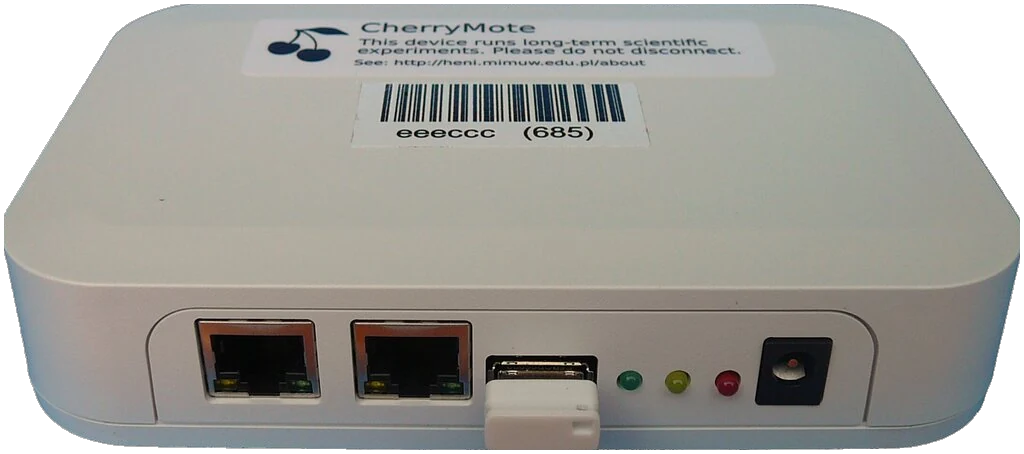
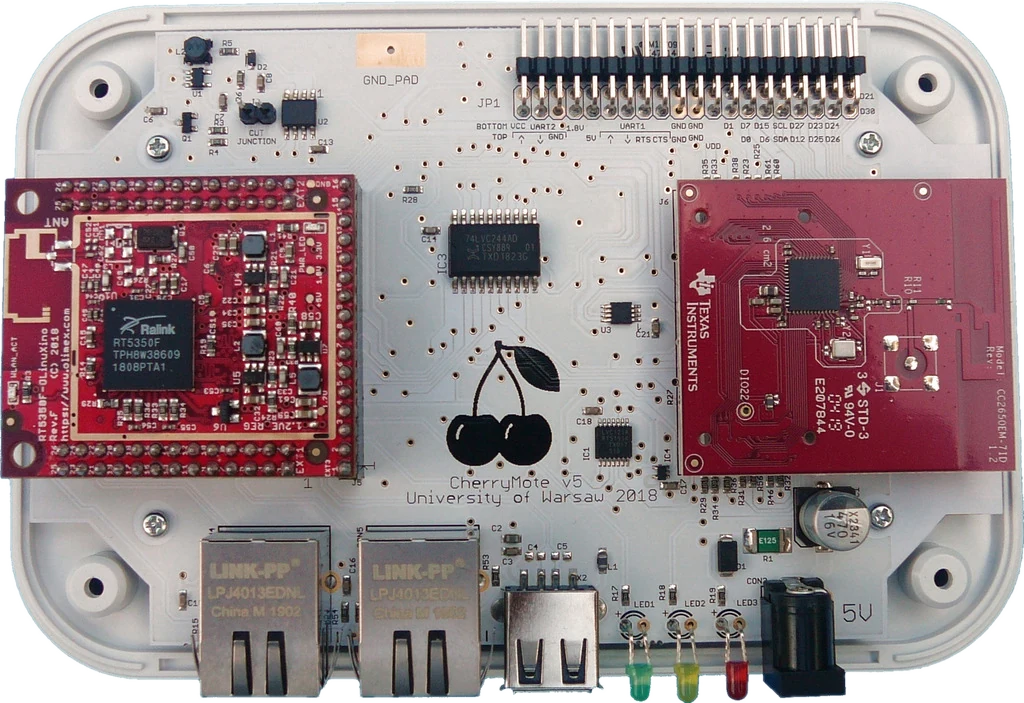
The building blocks of 1KT are CherryMotes, which consist of an Experimental Device coupled 1-1 with a Supervising Device. These two are connected by a main PCB and are enclosed in a white modern case. The main PCB also hosts a power meter, which can be queried in real time by both the Supervising Device and the Experimental Device itself.
CherryMote is built from off-the-shelf components. The Texas Instruments CC2650EM-7ID Reference Design is directly employed as the Experimental Device. Olimex RT5350F-OLinuXino acts, in turn, as the Supervising Device. Only the main PCB and the front-panel cutout are tailor-made, and their sources may be found in the download section.
950 CherryMotes are deployed throughout a sizable five-story building of the Faculty of Mathematics, Informatics, and Mechanics of the University of Warsaw. The devices are deployed directly in human spaces (e.g., under windowsills, behind desks, on file cabinets) of 168 rooms of virtually all types, including offices, computer labs, lecture halls, and shared areas, following an arrangement of each room.
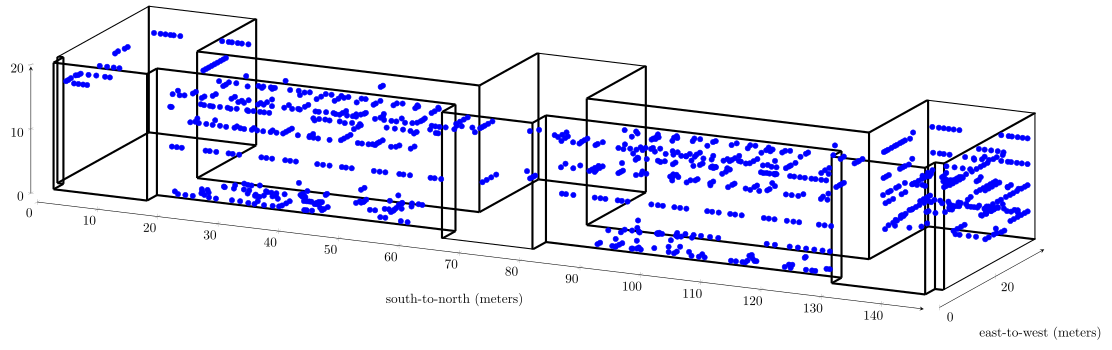
The remaining 50 CherryMotes are dedicated to development, preliminary evaluation, small-scale experimentation, and maintenance.
More information can be found in our research paper presenting 1KT.
Interactive visualization
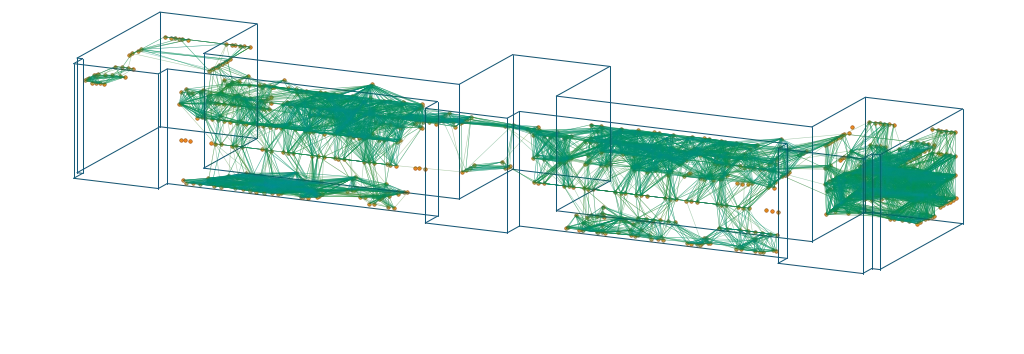
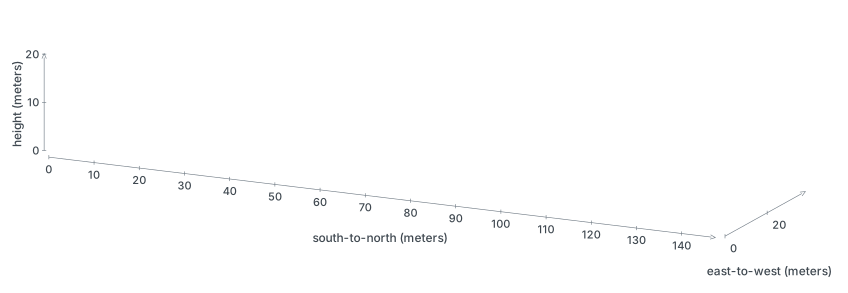
To get a feel for the deployment, you can explore it in your browser. The interactive visualization shows the 950 deployed CherryMotes in 3D, connected by the links measured during one day of the connectivity survey in February 2020, at the −3 dBm transmission power that keeps the network connected. It visualizes this PRR graph both as point-to-point connections and as a radio channel (IEEE 802.15.4 CSMA/CA). The visualization is meant to build an intuition for the network’s scale and behavior rather than to be a faithful radio simulation, and it needs a modern browser with WebGL2.
Open the interactive visualization to explore 1KT in 3D.
Research paper
The research paper presenting 1KT is open access: https://doi.org/10.1145/3479239.3485708
Citing:
@InProceedings{Banaszek:MSWiM:2021,
  author    = {Banaszek, Mateusz and Dubiel, Wojciech and \L{}ysiak, Jacek and D\k{e}bski, Maciej and Kisiel, Maciej and \L{}azarczyk, Dawid and G\l{}ogowska, Ewa and Gumienny, Przemys\l{}aw and Si\l{}uszyk, Cezary and Cio\l{}kosz, Piotr and Paszkowska, Agnieszka and R\"{u}b, Inga and Matraszek, Maciej and Aceda\'{n}ski, Szymon and Horban, Przemys\l{}aw and Iwanicki, Konrad},
  title     = {{1KT}: {A} Low-Cost 1000-Node Low-Power Wireless {IoT} Testbed},
  booktitle = {Proceedings of the 24th ACM International Conference on Modeling, Analysis and Simulation of Wireless and Mobile Systems},
  abstract  = {Testbeds remain indispensable instruments for experimentally evaluating IoT-oriented low-power wireless networking solutions. With the evolution of the field, they are increasingly expected to match envisioned deployment conditions of such solutions, notably in terms of scale. However, large-scale testbeds are scarce, likely because they have been believed to be expensive. This paper argues that this belief need no longer be justified by presenting the architecture and basic properties of 1KT, our new smart-building IoT testbed for solutions utilizing IEEE 802.15.4 and Bluetooth Low Energy. It comprises 1000 experimental devices deployed directly in human spaces of 168 rooms on all 5 floors of a sizable building. At the same time, its cost is relatively low considering the scale.},
  keywords  = {1KT, testbed, experiment, experimental testbed, large scale, low-power wireless network, Internet of Things (IoT), smart building, IEEE 802.15.4, Bluetooth Low Energy (BLE)},
  year      = {2021},
  month     = nov,
  series    = {MSWiM '21},
  location  = {Alicante, Spain},
  publisher = {Association for Computing Machinery},
  pages     = {109--113},
  numpages  = {5},
  isbn      = {978-1-4503-9077-4},
  doi       = {10.1145/3479239.3485708},
  url       = {https://doi.org/10.1145/3479239.3485708}
}
Conference talk
The paper was presented on November 24, 2021, during MSWiM 2021 in Alicante, Spain (held online). We invite you to view the presentation slides.
Publications
The following scientific publications use or refer to 1KT:
- Maciej Matraszek, Mateusz Banaszek, Wojciech Ciszewski, Artur Jamro, Wojciech Kordalski, Daniel Gutowski, Michał Siwiński, Bartłomiej Dalak, and Konrad Iwanicki: “CMEmu: Synthesizing a Cycle-Exact Model of Program Execution on ARM Cortex-M from In-Code Timing Measurements,” in MSWiM 2025: Proceedings of the 2025 International Conference on Modeling, Analysis and Simulation of Wireless and Mobile Systems, Barcelona, Spain. October 2025, pp. 350–359. https://doi.org/10.1109/MSWiM67937.2025.11308925. [Project page]
- Mateusz Banaszek, Markus Schuß, Carlo Alberto Boano, and Konrad Iwanicki: “RPL at Scale: Experiences from a Performance Evaluation on up to 700 IEEE 802.15.4 Devices,” in NOMS 2024: Proceedings of the 2024 IEEE/IFIP Network Operations and Management Symposium, Seoul, Korea. May 2024, pp. 1–6. https://doi.org/10.1109/NOMS59830.2024.10574969.
- Maciej Matraszek, Mateusz Banaszek, Wojciech Ciszewski, and Konrad Iwanicki: “FrankenTrace: Low-Cost, Cycle-Level, Widely Applicable Program Execution Tracing for ARM Cortex-M SoC,” in Proceedings of Cyber-Physical Systems and Internet of Things Week 2023 (CPS-IoT Week ’23), San Antonio, TX, USA. May 2023, pp. 72–77. https://doi.org/10.1145/3576914.3587521. [Project page]
- Mateusz Banaszek, Inga Rüb, Maciej Dębski, Agnieszka Paszkowska, Maciej Kisiel, Dawid Łazarczyk, Ewa Głogowska, Przemysław Gumienny, Cezary Siłuszyk, Piotr Ciołkosz, Jacek Łysiak, Wojciech Dubiel, Szymon Acedański, Przemysław Horban, and Konrad Iwanicki: “Lessons from Communication Problems that Nearly Jeopardized Development of Hardware-Software Support for a 1000-Device IoT Testbed,” in EWSN 2020: Proceedings of the 2020 International Conference on Embedded Wireless Systems and Networks, FAILSAFE Workshop, Lyon, France. February 2020, pp. 259–264. https://dl.acm.org/doi/10.5555/3400306.3400357.
Downloads
Below, we make available various materials about 1KT, the CherryMote devices, and the testbed’s hardware and software.
Files describing 1KT
- Connectivity network structure of 1KT, with edge weight representing PRR (collected December 2019 – March 2020)
- Sources of the plots in the 1KT paper
Sources of 1KT hardware
- Schematics of CherryMote
- Design files, schematics, BOM, etc., of CherryMote
- Design of the main PCB (online preview at Altium PCB Viewer)
- BOM of CherryMote (online preview at Octopart BOM Tool)
Sources of 1KT software
Operating systems supported on 1KT
Acknowledgments
1KT was developed within the HENI research project.
The testbed is currently managed by its project leader, Konrad Iwanicki, together with Mateusz Banaszek and Maciej Matraszek. Over the course of its development, it was built with contributions from Szymon Acedański, Piotr Ciołkosz, Maciej Dębski, Wojciech Dubiel, Ewa Głogowska, Przemysław Gumienny, Przemysław Horban, Maciej Kisiel, Małgorzata Koślacz, Dawid Łazarczyk, Jacek Łysiak, Anna Modzelewska, Marlena Nowińska, Agnieszka Paszkowska, Inga Rüb, and Cezary Siłuszyk.
The development of 1KT was supported by the National Centre for Research and Development (NCBR) in Poland under grant no. LIDER/434/L-6/14/NCBR/2015 within the LIDER-VI programme. The management of 1KT and the experimental research were supported mainly by the National Science Centre (NCN) in Poland within the OPUS programme under grant no. 2019/33/B/ST6/00448.
Get in touch
Would you like to use 1KT? Got questions or comments? Please get in touch with us by e-mail—you will find the address in the page footer below.